
We may earn a commission from links on this page, at no cost to you. Disclosure
Boston is best known for the American Revolution, which you can follow on the 2.5-mile Freedom Trail; for Fenway Park, the oldest ballpark in Major League Baseball; for the Boston Marathon, the world's oldest annual marathon; and for seafood, above all clam chowder and oysters. It is also known for Boston Common, the country's oldest park, for Boston cream pie, and for the universities around it, though Harvard and MIT are across the river in Cambridge.
Here is each of those claims to fame, with where to see it for yourself on a visit.
The American Revolution
This is the big one. The Freedom Trail, a red line set into the sidewalks in 1951, links 16 historic sites over 2.5 miles, from Boston Common to the Bunker Hill Monument in Charlestown, and following it is free. On the way you pass the Massachusetts State House, whose dome Paul Revere sheathed in copper in 1802; Faneuil Hall, where colonists protested the Sugar Act and the Stamp Act in 1764; the Paul Revere House, built about 1680 and downtown Boston's oldest building; and Old North Church, where two lanterns were hung on April 18, 1775. Small-group Freedom Trail history tours are bookable on Viator.
The Boston Tea Party of December 16, 1773, is told at the Boston Tea Party Ships & Museum on Fort Point Channel, in the same water where the tea went over the side.
America's oldest park and its first public botanical garden
Boston Common dates from 1634, and the city calls it America's oldest park; it was a cow pasture and a militia training ground long before it was a lawn. Next to it, the Public Garden was established in 1837 as the first public botanical garden in America. That is where the Swan Boats run in spring and summer and where the Make Way for Ducklings statue stands, at Beacon and Charles streets.
Fenway Park and the Red Sox
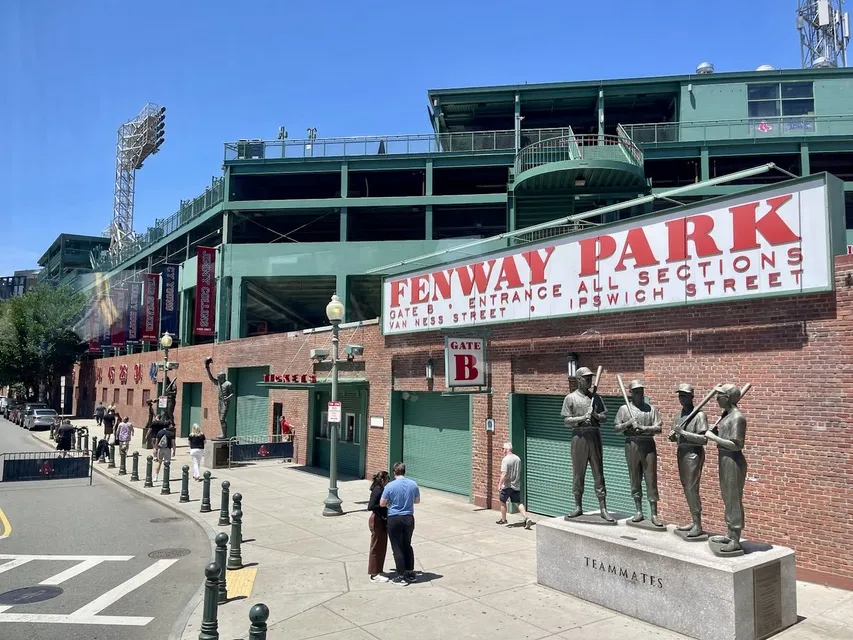
Fenway Park opened on April 20, 1912, and MLB lists it as the oldest ballpark in the major leagues. Its left-field wall, the Green Monster, stands 37 feet 2 inches high. You do not need a game ticket to go in: one-hour tours run every day of the year. Our guide to things to do in Fenway covers the rest of the neighborhood.
The Boston Marathon
The Boston Athletic Association first ran the marathon in 1897 and calls it the world's oldest annual marathon. It is traditionally held on Patriots' Day, the third Monday in April, and finishes on Boylston Street near Copley Square; the 2027 race is on April 19.
Sports beyond baseball
The Celtics and the Bruins play at TD Garden, by North Station. The Patriots are a Boston team in name only: they play at Gillette Stadium in Foxborough, a separate town south of the city.
Clam chowder, oysters and seafood
New England clam chowder and raw-bar oysters are what most visitors come to eat. Union Oyster House has served food at 41 Union Street since 1826 and calls itself the oldest restaurant in continuous service in the United States. For oysters from named New England farms, Neptune Oyster in the North End and Row 34 in Fort Point are both built around the raw bar.
Boston cream pie
The Omni Parker House, which opened in 1855, credits its own kitchen with inventing Boston cream pie, as well as Parker House rolls. Massachusetts law makes Boston cream pie the official dessert of the commonwealth.
Italian food in the North End
The North End is Boston's Italian-American neighborhood, and Hanover and Salem streets are lined with restaurants, cafés and bakeries. Regina Pizzeria has been on Thacher Street since 1926, and Giacomo's on Hanover Street is known for its line, its cash-only rule and its lobster sauces.
Universities
Boston's reputation as a college town is real, but the two most famous names are not in the city: Harvard University and MIT are in Cambridge, across the Charles River. Boston University and Northeastern University are in Boston.
The first large free public library
The Central Library in Copley Square heads the Boston Public Library, established in 1848 as the first large free municipal library in the United States; its 1895 McKim Building is free to walk through.
America's first subway
According to the MBTA, the Tremont Street subway opened in 1897 as North America's first subway tunnel, and it is still in use between Government Center, Park Street and Boylston stations on the Green Line.
Cheers
Cheers Beacon Hill at 84 Beacon Street opened in 1969 as the Bull & Finch Pub and inspired the setting of the TV comedy Cheers, which premiered in 1982. It faces the Public Garden and opens daily at 11 a.m.
To see several of these in one trip, start with our list of the top 10 things to do in Boston or the history-and-drinks route in our Boston tavern tour.
Sources: MLB, Boston Athletic Association, MBTA, Massachusetts General Laws ch. 2, sec. 41; listing facts from our linked listings. Checked October 1, 2026.