

The top 10 things to do in Boston are: walk the Freedom Trail; explore the North End, where the Paul Revere House and Old North Church stand; eat at Faneuil Hall Marketplace and Quincy Market; stroll Boston Common and the Public Garden; walk Beacon Hill and Back Bay to the Boston Public Library; see the Museum of Fine Arts; tour Fenway Park; visit the Museum of Science; board the Boston Tea Party Ships; and get out on the harbor at the New England Aquarium and the Harbor Islands. All ten are inside the City of Boston, and most are linked by the T or a walk.
The list runs roughly in the order a first-timer should tackle it, with the planning detail that matters for each. If you only have a day, do numbers 1 to 4: they join up on foot.
- Walk the Freedom Trail
- Explore the North End: Paul Revere House and Old North Church
- Eat at Faneuil Hall Marketplace and Quincy Market
- Stroll Boston Common and the Public Garden
- Walk Beacon Hill and Back Bay to the Boston Public Library
- See the Museum of Fine Arts
- Tour Fenway Park or catch a game
- Visit the Museum of Science
- Board the Boston Tea Party Ships
- Get out on the harbor
1. Walk the Freedom Trail
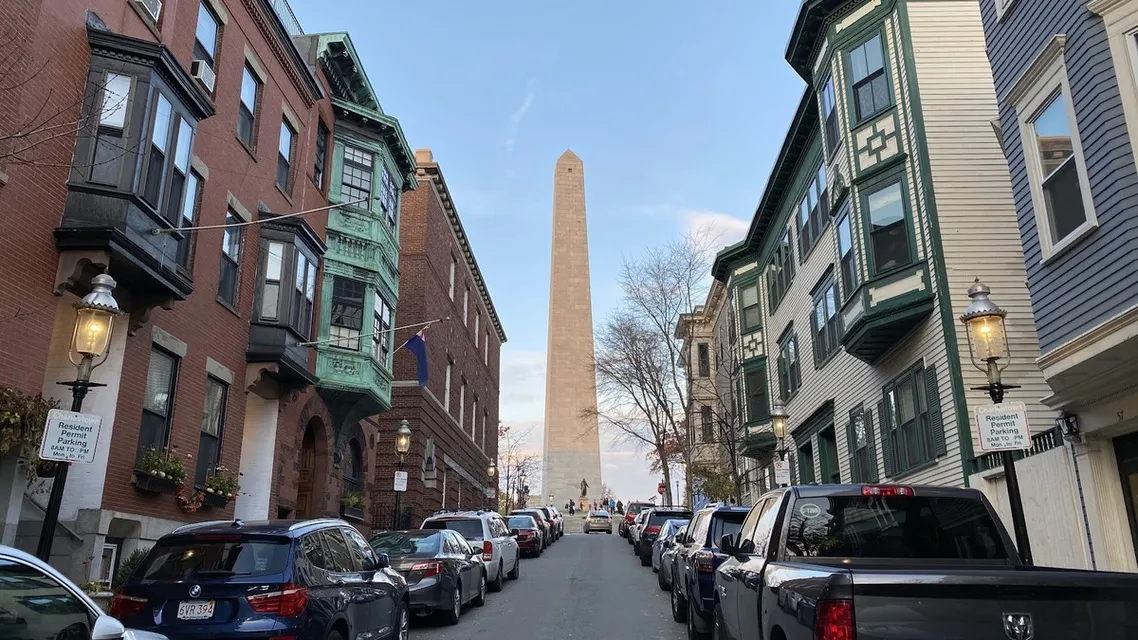
The Freedom Trail is Boston's number one sight: a free, 2.5-mile red line in the sidewalk linking 16 historic sites, from Boston Common to the Bunker Hill Monument in Charlestown. Most people start at the visitor information center at 139 Tremont Street, about 100 yards from Park Street station on the Red and Green lines. The route runs one way and does not loop back, passing the Massachusetts State House, Faneuil Hall and the North End before crossing to the Charlestown Navy Yard, where USS Constitution, the frigate launched in 1797, is free to board and the USS Constitution Museum sits across the pier. Following the line costs nothing; the Freedom Trail Foundation's costumed guides lead 90-minute tours year-round.
2. Explore the North End: Paul Revere House and Old North Church
The North End is the Freedom Trail's richest stretch. The Paul Revere House on North Square, built about 1680, is downtown Boston's oldest building and was Revere's home on the night of his ride; tickets are sold at the door. A few blocks on, Old North Church, opened in 1723, is the steeple where two lanterns were hung on April 18, 1775, and it is still a working Episcopal parish, so Sunday tourist hours begin at 12:30 p.m. Stay for dinner: the neighborhood is Boston's Italian-American quarter, with brick-oven pizza at the original Regina Pizzeria, seafood pasta at Giacomo's (cash only, expect a line) and oysters at Neptune Oyster. Haymarket is the nearest T stop.
3. Eat at Faneuil Hall Marketplace and Quincy Market
Faneuil Hall Marketplace combines history and lunch. Faneuil Hall, where colonists protested the Sugar Act and Stamp Act in 1764, is a free National Park Service visitor center with ranger talks in the Great Hall upstairs. Next door, Quincy Market, which opened in 1826 and turned 200 this year, holds more than 25 food counters under one roof, the easy place for chowder and a lobster roll. Street performers work the promenades from 11 a.m. to 9 p.m.
One correction to older guides: Boston cream pie did not come from Quincy Market. The Omni Parker House on School Street, itself on the Freedom Trail, credits its French chef Augustine Anezin with creating it in the 1860s, and it is still served at Parker's Restaurant, which opens for breakfast and lunch.
4. Stroll Boston Common and the Public Garden
Boston Common, laid out in 1634, is the country's oldest park and the Freedom Trail's starting point. Across Charles Street, the Public Garden was established in 1837 as America's first public botanical garden. Its Swan Boats, run by the same family since 1877, take 10- to 15-minute rides around the lagoon from mid-April to early September; the 2026 season has ended and they return in April 2027. Year-round, children head for the bronze Make Way for Ducklings sculptures at the Beacon and Charles Street corner.
5. Walk Beacon Hill and Back Bay to the Boston Public Library
From the Public Garden, walk up through Beacon Hill's gas-lit streets and brick row houses to the gold-domed State House, which offers free tours on weekdays, then west along Newbury Street's shops and cafes to Copley Square. There, the Boston Public Library's McKim Building, completed in 1895 as a palace for the people, is free to enter during library hours, with John Singer Sargent murals, the Bates Hall reading room and a quiet inner courtyard.
6. See the Museum of Fine Arts
The Museum of Fine Arts on Huntington Avenue holds nearly 500,000 works, from ancient Egypt and Nubia to contemporary art; give it most of a day. It is closed on Tuesdays and open until 10 p.m. on Thursdays and Fridays. A few minutes' walk away, the Isabella Stewart Gardner Museum, opened in 1903, is the opposite experience: one collector's palace, its galleries kept as she arranged them around a courtyard garden that flowers all year.
7. Tour Fenway Park or catch a game
Fenway Park has been home to the Red Sox since April 20, 1912. You do not need a game to see it: one-hour guided tours run every day of the year, leaving on the hour from the Team Store on Jersey Street, and include a stop on top of the 37-foot Green Monster when it is open. In season, a game is the bigger experience; take the Green Line, because parking nearby is limited. More in our Boston sports guide.
8. Visit the Museum of Science
The Museum of Science at Science Park, on the Charles River Dam, is built for doing rather than reading. The daily Lightning! show throws indoor bolts from the world's largest air-insulated Van de Graaff generator, Cliff the Triceratops anchors the fossil hall, and the Charles Hayden Planetarium and the five-story Mugar Omni Theater run shows until 10 p.m. on Fridays and Saturdays. Science Park station on the Green Line is across the road, which makes it the best rainy-day pick on this list for families.
9. Board the Boston Tea Party Ships
The Boston Tea Party Ships & Museum on the Congress Street Bridge tells the Revolution's opening act as theater: a one-hour tour led by costumed interpreters, starting with a colonial town meeting and moving aboard a restored ship, where everyone gets to throw tea overboard. Tours run on timed tickets, so book ahead in summer and school holidays.
10. Get out on the harbor
The New England Aquarium on Central Wharf is built around the Giant Ocean Tank, a four-story, 200,000-gallon Caribbean reef, with a penguin colony at its base and free harbor seals on the front plaza. It is about 100 yards from Aquarium station on the Blue Line, and entry is by timed ticket. From mid-May to mid-October, ferries from nearby Long Wharf North reach the Boston Harbor Islands: about 45 minutes to Georges Island, with Civil War-era Fort Warren, or 30 minutes to Spectacle Island, with trails and a beach. The 2026 ferry season ends on October 12.
If you have more time
View Boston, at the top of the Prudential Tower, shows the whole city at once and is open until 10 p.m. The Arnold Arboretum in Jamaica Plain is 281 acres of trees, free and open sunrise to sunset, at the end of the Orange Line. The Celtics and Bruins play at TD Garden above North Station, and the John F. Kennedy Presidential Library and Museum sits on Columbia Point in Dorchester. Across the river in Cambridge, which is a separate city, the Red Line reaches Harvard Yard and the Harvard Museum of Natural History.
How many days do you need?
Two full days cover numbers 1 to 6 at a comfortable pace; a third adds Fenway, the Museum of Science or the harbor. Boston is walkable and the T links almost everything above, so skip the rental car; our guide to using the T explains fares and lines. For day-by-day plans, see what to see in Boston in 2 days and our 4-day Boston itinerary; for food, our guide to what to eat in Boston.