
We may earn a commission from links on this page, at no cost to you. Disclosure
The best historical things to do in Boston start with the Freedom Trail, a free 2.5-mile red line past 16 sites from Boston Common to the Bunker Hill Monument. Go inside at least four of them: the Old State House, where the Boston Massacre happened outside in 1770; the Paul Revere House, built about 1680; Old North Church, of the two lanterns; and USS Constitution, launched in 1797 and free to board. Beyond the trail, the Black Heritage Trail on Beacon Hill, the Boston Tea Party Ships & Museum and the John F. Kennedy Presidential Library carry the story into the 19th and 20th centuries.
Here is what each site is, what it costs and how to fit them together.
Boston's historic sites at a glance
| Site | Why it matters | Cost |
|---|---|---|
| King's Chapel Burying Ground | Boston's oldest burying place, founded 1630 | Free |
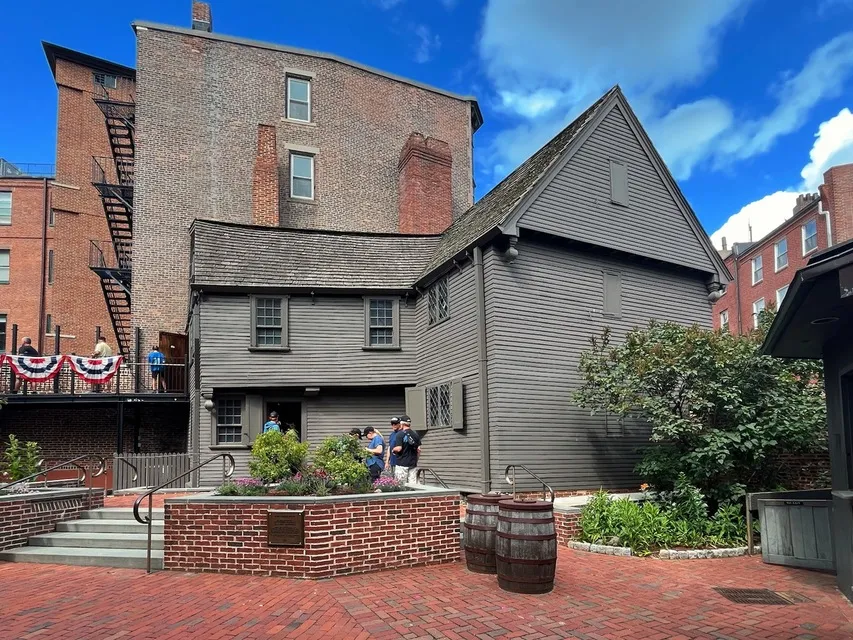
| Paul Revere House | Built about 1680; downtown Boston's oldest building | Paid admission; tickets at the booth |
| Old State House | Built 1713; Boston Massacre site, 1770 | Joint ticket with Old South: adults $18 |
| Old South Meeting House | Where the Boston Tea Party began, 1773 | Included in the joint ticket |
| Old North Church | Opened 1723; the lanterns of April 18, 1775 | Discovery Pass: adults $10 |
| Faneuil Hall | Meeting hall where colonists protested the Sugar and Stamp Acts in 1764 | Free |
| USS Constitution | Navy frigate launched 1797 | Free |
| Bunker Hill Monument | 221-foot obelisk, dedicated 1843 | Free |
| Massachusetts State House | Seat of state government since 1798 | Free weekday tours |
| JFK Presidential Library | Dedicated 1979, Columbia Point | Paid admission; 17 and under free |
The colonial town: burying grounds and the Paul Revere House
Boston's oldest layers are its graveyards. King's Chapel Burying Ground on Tremont Street dates from 1630 and holds John Winthrop, the colony's first governor. Also on Tremont Street, the Granary Burying Ground, set aside in 1660, holds Samuel Adams, John Hancock, Paul Revere and the five victims of the Boston Massacre, including Crispus Attucks. Both are free and open daily from about 9 a.m. to 4 p.m.
In the North End, the Paul Revere House on North Square was built about 1680, which makes it downtown Boston's oldest building; about 90 percent of the structure is original. Revere owned it from 1770 to 1800, so it was his home on the night of his ride. It is open daily from 10 a.m. to 5:15 p.m. until October 31, then 10 a.m. to 4:15 p.m. through mid-April, closed Mondays in January, February and March.
The road to revolution: 1764 to 1775
Faneuil Hall, where colonists protested the Sugar Act and the Stamp Act in 1764, is free: the National Park Service runs a visitor center on its ground floor, and rangers give talks in the Great Hall upstairs. Nearby on Washington Street, the Old State House was built in 1713 and is the oldest surviving public building in Boston; the Boston Massacre happened outside it on March 5, 1770. The Old South Meeting House, also on Washington Street, is where the meetings that led to the Boston Tea Party began. One ticket covers both, at $18 for adults and $10 for ages 6 to 17, and both are open daily from 10 a.m. to 6 p.m. in October.
Old North Church, opened in 1723, is Boston's oldest church building. On the night of April 18, 1775, its sexton and a vestryman hung the two lanterns of one if by land, two if by sea in the steeple. It is still a working parish; visiting hours are 10 a.m. to 5 p.m. Monday to Saturday and 12:30 to 5 p.m. on Sunday.
To see the Tea Party itself told as theater, the Boston Tea Party Ships & Museum in Fort Point runs one-hour guided tours led by colonial hosts, including time aboard its ships; general admission starts at $36. Read more in things to do near the Boston Tea Party Museum.
Charlestown: USS Constitution and Bunker Hill
The Freedom Trail ends across the Charlestown Bridge. USS Constitution, the frigate launched in 1797 and known as Old Ironsides, is an active-duty Navy ship and free to board, from Tuesday to Sunday; the USS Constitution Museum across the pier tells the crew's story and asks a suggested donation. Up the hill, the Bunker Hill Monument is a 221-foot granite obelisk on Breed's Hill, dedicated in 1843. Entry is free, and the top is reached only by 294 steps in a tight spiral. The MBTA ferry from Long Wharf to the Charlestown Navy Yard is an easy way back downtown.
Beacon Hill: the State House and Black history
The Massachusetts State House, with Paul Revere's copper under its gold dome, has been the seat of state government since 1798. Its tours are free, on weekdays only. Facing it across Beacon Street, the Shaw and 54th Regiment Memorial by Augustus Saint-Gaudens honors the first all-Black volunteer regiment in the Union army.
Beacon Hill was also home to a 19th-century Black community whose history the National Park Service tells on the Black Heritage Trail. Rangers lead walks past sites such as the Abiel Smith School, opened in 1835 as a segregated public school for Black students. The Museum of African American History at 46 Joy Street is open to the public Thursday to Sunday, 10 a.m. to 4 p.m.
The 20th century: the JFK Library
The John F. Kennedy Presidential Library and Museum, dedicated in 1979, stands on Columbia Point in Dorchester, still inside Boston. It is open daily from 10 a.m. to 5 p.m., visitors 17 and under enter free, and the Red Line to JFK/UMass connects with a free shuttle.
How to see Boston's history in one or two days
In one day, walk the Freedom Trail from the Common to the North End, going inside the Old State House and the Paul Revere House, and finish at Old North Church. With a second day, take the ferry to Charlestown for USS Constitution and Bunker Hill, then spend the afternoon on Beacon Hill or at the JFK Library. The Salem witch trials are a separate day trip; see things to do in Salem. For a pub stop with history, see the Boston tavern tour. For a guide, the small-group Revolutionary Story Tour is bookable on Viator.
Sources: Freedom Trail Foundation; King's Chapel Burying Ground; Granary Burying Ground; Paul Revere House; Old State House; Revolutionary Spaces; Old North Church; Boston National Historical Park fees; Bunker Hill Monument; USS Constitution Museum; Boston African American National Historic Site; Museum of African American History; JFK Library. Checked October 1, 2026.